5/18/10

As they say in "Miller's Crossing," it's an interesting question of ethics

A usually unquestioned staple of modern rhetoric is that we should not apply our contemporary moral or ethical values to historical figures. For example, Thomas Jefferson can be a hero of the country, even though he owned slaves, because, hey, everybody was doing it back in the day. But I have questions. 

Question 1: How does this assertion stand up to rigorous analysis by philosophers? What do actual ethicists say about this? (Paging Professor Hamilton...)

Question 2: Can it apply to living people, or do you have to be dead? I mean, Pat Buchanan (along with crazy uncles across the country) gets a bit of a pass for all the crazy stuff he says. But Strom Thurmond, probably because he needed to be re-elected, was expected to evolve with the times.

Question 3 comes from T-Rex:


5/17/10

What's the worst that could happen?

Over at the Atlantic, Joshua Green blogs:
A couple weeks ago, I suggested that the BP oil spill would actually make climate legislation less likely to pass the Senate, neatly highlighting the perversity of that institution. In the past, disasters often helped spur new legislation, rather than kill it. Yesterday, on "Meet the Press," Chuck Schumer agreed. Schumer said the spill "changed the politics" of the bill--for one thing, its Republican co-sponsor, Lindsay Graham, dropped out--and noted that "it's going to be harder to get one done given that drilling off coast was a part of the compromise."
It just goes to show how reality can dramatically trump shallow political calculation. For the last few months, compromising with Republicans on off-shore drilling seemed like good, pragmatic politics. It was a hot-button issue for the Palin-iacs. So offering up some concessions in that area to make important gains in other areas of energy and environmental policy just made sense. I thought so, anyway. Apparently, so did Pres. Obama. 

And, after all, what could go wrong?


img via

5/14/10

You guys are doing it wrong

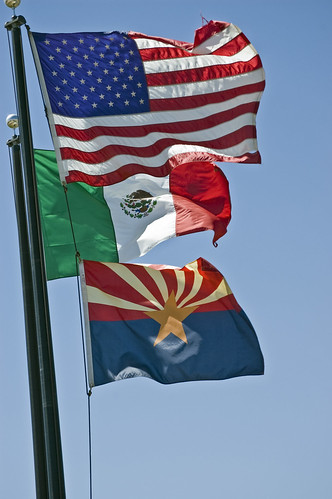
Racists and other types of idiots are having a quite a time in Arizona. Over at The Corner*, Mark Krikorian approvingly brings us the following news.

As a protest against Arizona’s controversial immigration law, the chambers of commerce from Nuevo Laredo to Matamoros have agreed to set May 25 as a “Day Without Mexicans” on the South Texas border.
Business leaders are calling on all Mexican nationals to avoid crossing the international bridges into the United States for any reason, but particularly for shopping, on that day.

Yes, of the people crossing the border, afternoon shoppers bringing money into the U.S. are clearly the worst.

I've been somewhat dismissive of the whole "Arizona's gone crazy" kerfuffle as a temporary and misguided reaction to legitimate problems with international drug violence. But Josh Marshall points to some uglier stuff going on, and says it is basically overt ethnic strife:

5/13/10

Print this out

Put the print out by your TV. And prepare for some early morning drinking (if that's your thing).
It's time for World Cup 2010. England v USA (USA! USA!) on Saturday, June 12:

5/12/10

Regarding our crushing tax burden

From our nation's most colorful newspaper:
Amid complaints about high taxes and calls for a smaller government, Americans paid their lowest level of taxes last year sinceHarry Truman's presidency, a USA TODAY analysis of federal data found.
...

Federal, state and local taxes — including income, property, sales and other taxes — consumed 9.2% of all personal income in 2009, the lowest rate since 1950, the Bureau of Economic Analysis reports. That rate is far below the historic average of 12% for the last half-century. The overall tax burden hit bottom in December at 8.8.% of income before rising slightly in the first three months of 2010. 


"The idea that taxes are high right now is pretty much nuts," says Michael Ettlinger, head of economic policy at the liberalCenter for American Progress. 
I've been saying forevers and evers that it's time to raise taxes. An increase to the average tax rate of the last 50 years (properly progressive, mind) would go a long way towards righting our economic boat, especially as revenues are likely to bloom along with the recovering economy.


That's the main point of this post, but let me also register a personal peeve about these kinds of articles. Consider:

Individual tax rates vary widely based on how much a taxpayer earns, where the person lives and other factors. On average, though, the tax rate paid by all Americans — rich and poor, combined — has fallen 26% since the recession began in 2007. That means a $3,400 annual tax savings for a household paying the average national rate and earning the average national household income of $102,000. [Emphasis added.]
Emphasis added. So, aside from my work friends (who are all captains of industry, etc., etc.) I know very few people who have a household income of over $100K. This is a case where "average" really, really, does not mean "typical."


My friends may all be artists, writers, teachers, and other societal misfits, but in terms of income, they are mostly doing better than the typical American family. The typical American family would be thrilled to have their household income skyrocket to $102,000. 


(Of course, if it did, they would immediately start grumbling about taxes and voting Rebublican.) 


4/20/10

It is a golden age for 10 year-old boys

One of the great things about kids, your own or somebody else's, is introducing them to things. Not in a skeezy priest way, I mean things like giving a kid their first lemon wedge or snow cone. It's even better when you have fond memories of the shared experience. The Princess Bride is popular in my house, and sharing that cross-generationally has been great.

All of that is to say, if you know a 10 year-old boy, they would enjoy the A-Team.


4/6/10

We do like our gold-embossed sushi rolls

According to Bundle's first "How America Spends" report, the top-spending Americans lived in Austin in 2009. Households in the Texas capital averaged $67,076 in overall household expenses (excluding mortgage and rent, which are not included in Bundle's breakdown). Austin's annual spending is 77% higher than the national average of $37,782. Households in Scottsdale, Ariz., ranked No. 2, spending $64,687 on average for 2009.
So where's New York City? The five boroughs came in No. 53, with $37,435 in spending for 2009, just below the U.S. average. But if Manhattan were its own city -- and some people do think it is -- the richest of the boroughs would land at No. 3 on Bundle's list, with annual per-household spending at $59,602.

Before you get all up in our faces about spending money we could be saving, and so forth, please keep in mind that we. are. the. best. That's important to remember.

But also, the data seems to indicate that you would spend just as much if you moved here. (Well, maybe not you dear non-Austin-based, frugal reader. But, you know, people.)
Bundle's data excludes spending on mortgage and rent, which explains why New York City doesn't top the list and why the top 25 includes relatively affluent towns with low housing costs. (Ditto for Los Angeles, with its sprawling geography and socio-economic diversity. That city is No. 42 with $39,422 spent in 2009, 4.3% higher than the national average.)

More importantly, the data reveals how spending persists, across circumstances. A lower cost of housing often means that people spend more on food, restaurants and travel. It's why residents of Fresno, Calif., spend more on shopping, gas and auto expenses than their northern neighbors in San Francisco. In other words, you can move to a cheaper city, but you won't necessarily spend less.


images via here and here.

4/1/10

Heh

A different kind of company name

4/01/2010 12:01:00 AM
Early last month the mayor of Topeka, Kansas stunned the world by announcing that his city was changing its name to Google. We’ve been wondering ever since how best to honor that moving gesture. Today we are pleased to announce that as of 1AM (Central Daylight Time) April 1st, Google has officially changed our name to Topeka.

3/28/10

The state of the military-industrial entertainment educational toy complex

In case you hadn't heard the news: don't do your educational toy shopping at the Dollar Tree.

3/25/10

Thinking seriously about abandoning Haloscan / JSKIt comments

.... and transitioning to Blogger comments. What say you, dear readers?

3/24/10

Best fried rice recipe (work in progress)


This is an evolving recipe. Please post any suggestions.

You will need:

• 1 cup rice uncooked rice or 3 cups cooked rice.
• 3 to 4 T toasted sesame oil
• 1 onion, chopped
• 3 to 4 cloves garlic, chopped
• 2 eggs
• 1/2 cup cilantro, chopped
• 3 cups other veggies (can be anything, but I like baby carrots cut in half lengthwise, sliced mushrooms, and chopped zucchini)
• one package firm tofu
• soy sauce
• a really hot chili sauce (we use the "cock sauce," pictured right)


Make the rice.

Make it the day before and put it in the fridge (or just use leftover rice from another dish that's already been in the fridge). There is no other way to get the right texture. Although, if you cannot wait 24 hours, you can get close by slightly undercooking the rice.

Press the tofu.

My method is to set down a flat plate, then some paper towels, then the tofu (sliced so it can lay in one half-inch flat layer on the plate), then more paper towels, then another plate, then about 10 heavy cookbooks. I let the books press the tofu for about 2 hours if I have that long. The longer, the better.

Afterwards, slice it into strips or cubes.

Heat the oil in a wok, and add tofu.

You want to brown the tofu a bit before adding any other veggies. Use high heat.

Add the veggies.

What order depends on the vegetables, of course. With the ones I suggest, add in the carrots first and brown them slightly before adding anything else. Then add the zucchini, and let that go for a few minutes, stirring occasionally. Then add the garlic and onion. Now things should be smelling pretty good.

Stir frequently after this so that the garlic doesn't burn.

Add the rice.

Stir fry for about 10 minutes on high heat. I often add a dash more toasted sesame oil at this point.

Add the eggs one at a time.

If you don't mind gloopy rice, the easiest way to do this is to crack the egg over the whole mess and just continue to stir fry. But what I do instead is to push aside the rice from a section of the bottom of the wok and fry the egg there for a couple minutes before stirring it in to the rest of the rice.

Stir in most of the cilantro. Stir fry for 2 more minutes.

If you hate cilantro, you can use fresh basil.

Remove from heat.

Add soy sauce and hot sauce to taste.

Garnish w/ a little cilantro. Serve with spring- or egg-rolls and Kirin Ichiban beer.

3/23/10

I didn't think the President was going to sign the healthcare bill until the reconciliation package had passed

In retrospect it makes sense: It totally takes the wind out of Republican sails. But I bet you there were at least a couple of House members caught off guard as well.

3/12/10

This machine makes Mozart


Finally, Cope's program could divine what made Bach sound like Bach and create music in that style. It broke rules just as Bach had broken them, and made the result sound musical. It was as if the software had somehow captured Bach's spirit -- and it performed just as well in producing new Mozart compositions and Shakespeare sonnets. One afternoon, a few years after he'd begun work on Emmy, Cope clicked a button and went out for a sandwich, and she spit out 5,000 beautiful, artificial Bach chorales, work that would've taken him several lifetimes to produce by hand.

I'm going to try to get a hold of some of these computer-generated works and give you, dear readers, the official Bellman review. But in the meantime, I want to focus on what Jason Kottke said when he linked to the article about Cope:
Gosh it's going to get interesting when machines can do some real fundamental "human" things 10,000x faster and better than humans can.

Humanists, take note! This is not a threatening development.

First, let me posit that while Cope's work's works may not rise to the level of human genius, some algorithms will reach that benchmark during our lifetimes (except maybe your lifetime, Oldy McAbouttodie).

This assertion is not one most of my writer, artist, or musician friends agree with, but they (you?) are wrong, wrong wrong. It's inevitable.

Second, this is not a bad thing. Yes, there will be violent change to our idea of what makes a person or a particular work of art valuable or important. But this change will ultimately be for the better. How could being surrounded by the best art ever made, freshly baked each week, possibly be bad? Computers will find ways to reliably speak to our souls in ways that we rarely have.

And we will all be immensely--almost inconceivably--enriched. The future, she kicks ass.
---
(img via Curved White)

3/10/10

[Updated] Supertrains come to Austin!*


I love my fair city, but if there is one thing that keeps Austin from being a truly world-class metropolis, it's the terrible transportation infrastructure. We're relentlessly developing a city in which car ownership is required to do just about anything. And if you do happen to have a car, you then have to deal with the fact that everyone else has to have a car, and that means they have to have wide roads and huge parking lots.

After reading that paragraph, you might expect me to be ecstatic that Austin is finally opening its "Red Line " commuter rail in just one week (only two years and one week late!). And while I am excited that we are taking our first steps into hard core public transporation infrastructure, there is one painful flaw in Cap Metro's rail effort: the idiotic schedule.

Rush hour only? No supertrains on weekends?

W. T. F.

Okay, they are calling it "commuter rail," not "super happy Jason fun time rail," and that's fair. But let's outline a few things I can't do using the Red Line.

  • I can't take the family to the Zilker kite festival on the train, so that I bypass the traditional parking clusterfrak.
  • I can't opt to take the train home from drinks downtown rather than climb in my car while dangerously buzzed.
  • I can't work late at the office, without having to find alternative transport home.

I know, I know, it costs money to run the supertrain. And Austinites don't want to pay for the train in the first place, because they don't see what it gets them personally (we all own cars, you know?).

But if there's one way to make sure that we never learn how awesome intracity rail can be, it's to make sure that it never ever seems like a good idea to try it out.

With this schedule, most of us our going to have only one experience with the Red Line: waiting--in our cars--for the train to get through a crossing.

UPDATE: From twitter, @ryanrumsey responds:
@originaljason Sounds like LA's PT planning. Did you know LA has a subway? No? Either do many in LA. Limited service & destinations.

@originaljason Oh, and LA's subway...it's the 'Red Line'.

---
* DISCLAIMER: Trains may not be very super.

3/2/10

A good place to grow ten to the hundredth power potatoes

AKA, Ad Astra Per Muto Nomen Rabidus (forgive the amateur Latin, it's supposed to mean "To the stars through crazy name change"...either that, or I've just cast some damned wizarding spell).

I was eating dinner at a favorite Vietnamese place last night when I saw a report on the local news about the most recent ridiculousness coming out of my home state. Topeka, my very home town, is changing its name to "Google" for the month of March. Fortunately its unofficial. You can read all about it here. And here is a CNN article about the same subject that makes Mayor Bill Bunten sound a bit...dim.

And, "ToPikachu"? What? It's true. You can never go home again.

Barry Hannah 1942-2010

"Well, yeah, I’m proud, but I tell you, the older you get as a writer, the more modest you get and the more you should shut up. You’re less arrogant, with good reason. There’s just a hell of a lot going on in the world. You’ve not penetrated too many consciousnesses. When I was twenty-one, I thought that you write a book and the world paid attention, man. There was no doubt. Then you grow up and you see that that’s not it at all. That you have to love it itself. And that you’re working for about the top 3 percent, max, of America. And they’re literary. That’s not the nuclear scientists, who ain’t going to read you. You’re working with literary folks, 3 percent of the reading public, and it becomes a tiny club and you should have more modesty.

But Cormac McCarthy, Faulkner, Flannery O’Connor, Virginia Woolf, that’s what you should shoot for. Beckett. The best of Beckett’s prose, you know. If you can get that close to the heart, and that honesty, with some music, why write the other kind of books that many people can agree with and not be disturbed by? I don’t like the books where everybody shakes their heads and says, How true, how true. I want to be in a region that’s beyond good and evil. Where it’s just fireworks or Mozart. Where there’s just no explanation. That’s what McCarthy and Faulkner do for me. It’s better than any review. That’s what I’m after."

-from The Pleasures of Influence: Conversations with American Male Fiction Writers

Evolutionary theory really revolutionary?

Interesting article about culture and evolution in the Times today. It begins thusly:
As with any other species, human populations are shaped by the usual forces of natural selection, like famine, disease or climate. A new force is now coming into focus. It is one with a surprising implication — that for the last 20,000 years or so, people have inadvertently been shaping their own evolution.
My question is, why is this so surprising? I've long just assumed that culture exhibited both pro- and anti-evolutionary forces. Who knew this was up for debate?

In other news, that show Archer is hilarious. Whether it is working for or against evolution has yet to be seen.

eXTReMe Tracker