Showing posts with label books. Show all posts

7/21/10

Q. What do you read, my lord?


Answer is, obviously, "words, words, words."

Q. What's the matter? The matter is contained in the words. Not in the cover art. Not in the spine. And not in the typeface. Groooober says, about typeface:
So the knock against e-books, in my opinion, is that they’re not carefully dressed like print books are. They’re wearing generic uniforms.
Fair enough. But think back to your favorite book in the world. Do you have a strong association with the cover art? With the spine of the book? With the size or color of the page?

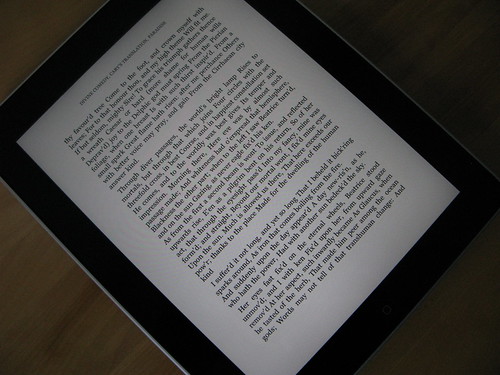
For me, the answer to the above is yes, but barely. Even the smell of an old book (which is a powerful and distinctive memory) is amazingly secondary to the matter of the words. The ability to read book after book after book on my (lightweight, always in my pocket) phone is, for me, an extraordinary evolution and enhancement of the written word.

What about you, dear reader? Do you like ebooks, or is your relationship with books less about the words and more about the paraphernalia?

12/14/09

Fatherhood's worst surprise so far


Speaking of reading books...

The experience of being a father is full of surprises for me, and most all of them are pleasant. But there's one that's really, really unpleasant.

It makes me an emotional wreck when I sit down to read fiction of any sort that in any way relates to childhood. Even (perhaps especially) descriptions of childhood woes that are cliched or trite have a devastating effect on me as a reader. I often have to put the book down and try again later.

Max (pictured), I blame you.

5/11/09

Stephen King insults some of his readers, but he has a point.


via D. Fireball,
“The question is, how much time and energy do I want to spend chasing these guys,” Stephen King wrote in an e-mail message. “And to what end? My sense is that most of them live in basements floored with carpeting remnants, living on Funions and discount beer.”

On the one hand, it's easy for Stephen King to say this. He might not miss a few hundred dollars here and there in revenue lost to book piracy.*

But on the other hand, he's totally right. Be it music, movies, books, or recipes, there are some bootleggers who would otherwise never be exposed to that intellectual property, because they would never, ever, evereverever, pay full market value for it.

On the gripping hand, the real victims of piracy are second-hand stores and libraries, and both are institutions for which I have many positive feelings... which are rapidly turning into just "nostalgia." (Been nice knowing you, Dusty Bookshelf and Manhattan Public Library!)

---
* Book piracy, brought to you by the letter RRRRRRRR!

4/13/09

Not as useful a reference work as one might hope


Signs, Omens, and Superstitions By Astra Cielo (1918)

Read it. Or don't.

3/6/09

i read sometimes, too


Overall, using the Kindle app for the iPhone has been a positive experience. Here's what I like about it:

I always have my phone

So I always have any books I've loaded into the app. That's not true of the other books I'm reading, and probably wouldn't be true of a full Kindle (were I to buy one (which I won't)).

Reading is surprisingly easy

I though it would be more difficult, but it is very natural and almost as immersive as reading from a physical book... and actually more immersive than reading some awkwardly sized or poorly put together books.

The backlight is also nice, when trying to read in the dark without waking either my wife or my 1-month-old baby.

It's quick, easy, and relatively cheap to get books

I wish the interface were a little clearer, but in general it's got the same ease of use as the iTunes store... making it really easy to spend your money on their product!

It's not all great. And unless they can accommodate all the free books on the internet (as far as I know they can't), they will ultimately lose the market to somebody who can.

12/8/08

The viral marketing continues

At the end of the day, it’s hard for me not to reach the conclusion that the backlash is, not coincidentally, coming just as Gladwell’s hit upon a politically charged topic and reached conclusions that are discomfiting to the very successful. I’ve seen a few people express the notion that Gladwell’s conclusion — that success is determined largely by luck rather than one’s powers of awesomeness — is somehow too banal to waste one’s time with. I think those people need to open their eyes and pay a bit more attention to the society we’re living in. It’s a society that not only seems to believe that the successful are entitled to unlimited monetary rewards for their trouble, but massive and wide-ranging deference.

Beyond that, it’s a society in which the old-fashioned concept of noblesse oblige has largely gone out the window. The elite feel not only a sense of entitlement, but also a unique sense of arrogance that only an elite that firmly believes itself to be a meritocracy can muster. Gladwell not only shows that this is wrong, but he does an excellent job of showing why it feels right. He explains that success does, in fact, require hard work — lots of it — and that people who think they got where they are through effort rather than good fortune are at least half right. The issue is that in some ways the best luck of all is the luck to be in a position to do hard work at a time when it pays off. | Yglesias |

10/4/07

Till Armageddon no shalam no shalom

When I was a freshman in college back in the eighties, I took an introductory survey course in the humanities. One of the books we read was Into That Darkness, Gitta Sereny's biography of Franz Stangl. This was, of course, at the height of the canon wars, so I suppose that Bloom and Hirsch would have been scandalized to see that book on the reading list. Truth be told, I probably would have sympathized with them. As much as I enjoyed the book, the central question it posed seemed faintly ridiculous. Could the Holocaust happen here? Could decent people, step by tiny step, lose all human moral sense? Of course not.

8/21/07

I saw the best minds of my generation do what now?


Luc Sante has a short and interesting review in the Times of the 50th anniversary release of Kerouac's On the Road. The new release reprints the text from the original scroll Kerouac hammered out. There are edits of course, but fewer commas and literary pretensions, apparently.

There are two links to original reviews in the Times , as well as a photo gallery of foreign editions of the book. This is from a 2000 Chinese edition. What the hell? Beats as Brat Pack, is that what I'm seeing? China's funny.

7/20/07

Enoughus alreadyorum

Pardon my elvish, but I am fucking sick to death with this Harry Potter shit. And no, it's not Rowling envy. There, I just had to say that.

Of course, without this cultural force at work, we wouldn't have very amusing things like this to laugh at.

7/5/07

She's not bitter

`Michael Chabon has spent considerable energy trying to drag the decaying corpse of genre fiction out of the shallow grave where writers of serious literature abandoned it.' Ruth Franklin (Slate, 8 May 2007)

Something woke her in the night. Was it steps she heard, coming up the stairs -- somebody in wet training shoes, climbing the stairs very slowly ... but who? And why wet shoes? It hadn't rained. There, again, the heavy, soggy sound. But it hadn't rained for weeks, it was only sultry, the air close, with a cloying hint of mildew or rot, sweet rot, like very old finiocchiona, or perhaps liverwurst gone green. There, again -- the slow, squelching, sucking steps, and the foul smell was stronger. Something was climbing her stairs, coming closer to her door. As she heard the click of heel bones that had broken through rotting flesh, she knew what it was. But it was dead, dead! God damn that Chabon, dragging it out of the grave where she and the other serious writers had buried it to save serious literature from its polluting touch, the horror of its blank, pustular face, the lifeless, meaningless glare of its decaying eyes! What did the fool think he was doing? Had he paid no attention at all to the endless rituals of the serious writers and their serious critics -- the formal expulsion ceremonies, the repeated anathemata, the stakes driven over and over through the heart, the vitriolic sneers, the endless, solemn dances on the grave? Did he not want to preserve the virginity of Yaddo? Had he not even understand the importance of the distinction between sci fi and counterfactual fiction? Could he not see that Cormac McCarthy -- although everything in his book (except the wonderfully blatant use of an egregiously obscure vocabulary) was remarkably similar to a great many earlier works of science fiction about men crossing the country after a holocaust -- could never under any circumstances be said to be a sci fi writer, because Cormac McCarthy was a serious writer and so by definition incapable of lowering himself to commit genre? Could it be that that Chabon, just because some mad fools gave him a Pulitzer, had forgotten the sacred value of the word mainstream? No, she would not look at the thing that had squelched its way into her bedroom and stood over her, reeking of rocket fuel and kryptonite, creaking like an old mansion on the moors in a wuthering wind, its brain rotting like a pear from within, dripping little grey cells through its ears. But its call on her attention was, somehow, imperative, and as it stretched out its hand to her she saw on one of the half-putrefied fingers a fiery golden ring. She moaned. How could they have buried it in such a shallow grave and then just walked away, abandoning it? "Dig it deeper, dig it deeper!" she had screamed, but they hadn't listened to her, and now where were they, all the other serious writers and critics, when she needed them? Where was her copy of Ulysses? All she had on her bedside table was a Philip Roth novel she had been using to prop up the reading lamp. She pulled the slender volume free and raised it up between her and the ghastly golem -- but it was not enough. Not even Roth could save her. The monster laid its squamous hand on her, and the ring branded her like a burning coal. Genre breathed its corpse-breath in her face, and she was lost. She was defiled. She might as well be dead. She would never, ever get invited to write for Granta now.

link, probably via boingboing.

4/27/07

(Un)like father, (un)like son

I can't recall which class I read it for, but I believe Money by Martin Amis was the only book in it that I actually finished. Recommended. This is my first post in a good long while, and I'm just testing, bloggy blog testing...and tipping you off to a good article in the New York Times Magazine about Kingsley and Martin, the Amis authors. I wonder what it's like to be so close to one's father that one can recount information like the following with authority:

That Kingsley was an enthusiastic drinker and philanderer (someone who “lived for adultery,” his son says) was well known to most of his British readers, who watched with amusement or dismay as he turned himself over the years from a handsome young socialist into a monstrous caricature of an old buffer: fat, reactionary, alcoholic, rude and intolerant. He grew so devoted to the queen (who knighted him in 1990) that he had erotic dreams about her. They usually began, Martin says, with Sir Kingsley attempting to paw the royal chest and Her Majesty protesting: “No, no, Kingsley. We mustn’t.”

1/29/07

Sometimes it just turns out that way

Ladies take note: If I can find my long underwear, I'm wearing it today.

In other weather related news, Heavy Weather is starts out as a pretty good contribution to the cyberpunk tornado chaser genre but falls apart in the last 30 pages or so.

Speaking of post-apocalyptic sci-fi, Children of Men is a pretty good contribution to the genre, even though it sometimes hits you over the head with its politics.
eXTReMe Tracker